Asia
Xiangqi
Chinese chess: a river, palaces and a cannon that jumps to capture.
 Play in your browser
The game runs in your browser and needs JavaScript.
What you can do here
- Bots from Novice to Club player, or friends online or at the same device
- A short course on the rules and the classic techniques, task by task on the board
- Over 2,800 puzzles that adapt to your level
- Characters or symbols on the pieces, algebraic or WXF notation
How Xiangqi is played
Xiangqi is Chinese chess, the most popular board game in China, also played in Vietnam as cờ tướng. The pieces stand on the points where the lines cross, not in squares. The goal is to checkmate the opposing general: to attack it so that no move can save it. An attacked general is in check, and no move may leave your own general attacked.
The board
The board has nine files and ten ranks of points. The river across the middle divides the two halves, and each side has a palace of nine points with two diagonals. Red moves first.
The pieces
The chariot moves any number of points along a line, forward, back or sideways, but not over other pieces. The horse steps one point straight and then one diagonally outward; a piece on that first point blocks it. The elephant moves exactly two points diagonally, cannot pass a piece on the point between and never crosses the river. A piece captures by moving onto an enemy piece.
The cannon
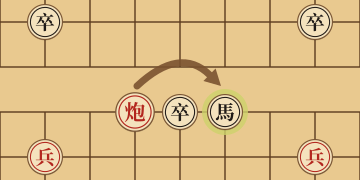
The cannon moves like the chariot, but it captures only by jumping over exactly one piece, of either side, onto an enemy piece behind it.
Generals and palace
The general steps one point along a line, the advisors one point diagonally, and neither leaves the palace. The two generals may never face each other on a file with nothing between them.
Soldiers
A soldier steps one point forward. Once it has crossed the river, it may also step one point sideways. It never moves back and does not promote.
Winning and draws
Checkmate wins, and a side that has no legal move loses too, even when it is not in check. Fifty moves without a capture are a draw, and so is a position where neither side has a piece left that can attack.
Repetition
When a position occurs for the third time, the side that gave check with every move of the repetition loses. Otherwise the side that kept chasing a piece loses: an unprotected one, or a stronger one such as a chariot attacked by a horse. If neither side did, or both did, the game is drawn. These are the rules of the Asian Xiangqi Federation as Fairy-Stockfish and pychess play them.
Handicaps
In China the stronger player may give a horse, both horses, a cannon or a chariot (让子), as agreed before the game; here the giver plays Red, loses the piece on its left and moves first. Folk rules often protect some of the giver’s pieces too (an unmoved central soldier after horse odds, for example); this game leaves them out. The bot can give them, or you can (the setup’s "Handicap").
The story
China · Tang dynasty, 8th–9th century; today's form under the Song, 11th–12th century
When and where
The oldest clear account of xiangqi is a tale by Niu Sengru, a Tang minister who died in 847: a man dreams of a battle where a horse leaps aslant and chariots only drive forward. Most historians derive the game from the Indian chaturanga; some Chinese scholars argue that it began in China and spread west.
How it changed
Under the Song dynasty, in the 11th and 12th centuries, poems first mention the river, and a copper set from the early 12th century already has cannons, drawn as catapults. The river is still called “Chu river, Han border”, after the war between Chu and Han (206–202 BC).
Today
Xiangqi is the most popular board game in China and is widely played in Vietnam, where it is called cờ tướng, “the general’s chess”. Asian and world federations run tournaments and award grandmaster titles.
Did you know?
The two sides do not share every name. Red’s general is 帥 shuai and Black’s is 將 jiang, and Black’s elephant 象 is the character that names the game, while Red’s 相 means minister.
Original piece names
shuai 帥 / jiang 將 (general (Red / Black)) · shi 仕 / 士 (advisor) · xiang 相 / 象 (elephant (Red’s character means minister)) · ma 傌 / 馬 (horse) · ju 俥 / 車 (chariot) · pao 炮 / 砲 (cannon, once a catapult) · bing 兵 / zu 卒 (soldier)
Sources: Wikipedia · Jean-Louis Cazaux
More games
Chess and variants
- Chess · Classic chess, or Chess960 with a shuffled back rank.
- Chess960 · Fischer random chess: the back rank starts in one of 960 setups.
- Antichess · Losing chess: give away all your pieces, captures are compulsory.
- Extinction chess · No check: take every enemy man of one kind, the king or all the pawns.
- Knightmate · Chess with a royal knight: mate the knight; the kings are ordinary men.
- Atomic chess · Every capture is an explosion that clears the pieces around it.
- Crazyhouse · Captured pieces change sides and can be dropped back onto the board.
- Hostage chess · Captured men become hostages and come back by exchange or from the airfield.
- Circe chess · A captured man goes straight back to its home square, if it is free.
- Three-check · Chess where the third check wins, so every check counts.
- King of the Hill · Chess where a king that reaches the centre wins at once.
- Jeson Mor · Mongolia’s nine horses: take the centre and hold it for a move.
- Racing Kings · No pawns, no checks: the first king on the far rank wins.
- Horde · 36 white pawns storm a full black army.
- Dunsany’s chess · Lord Dunsany’s game of 1942: 32 pawns against a full army.
- Los Alamos chess · Chess on 6 × 6 without bishops, the first game a computer played (1956).
- Gardner’s minichess · Chess on 5 × 5 with every piece, proved a draw with best play.
- Duck chess · After every move you move the duck, which blocks everyone. No check.
- Marseillais chess · Two moves a turn, with one piece or two; White starts with one.
- Progressive chess · One move, then two, then three: each turn is one move longer.
- Fog of War · You only see where your pieces can move. Capture the king to win.
- Kriegspiel · Only your own pieces in sight; an umpire judges every move.
- Alice chess · Two boards: every piece that moves passes through to the other one.
- Raumschach 3D · Chess in a 5 × 5 × 5 cube: five boards stacked, and the unicorn.
- Old Raumschach · Maack’s cube as played before 1919: five pawns above the pieces.
- Friendly Chess · Nothing is captured: pieces unite and set off chain reactions.
- Ultima · Every piece captures its own way, and the immobilizer freezes.
- Gliński’s hexagonal chess · Chess on 91 hexagons: three bishops, rooks in six directions.
- McCooey’s hexagonal chess · Hexagonal chess closer to chess: seven pawns that take diagonally.
- Shafran’s hexagonal chess · Hexagonal chess on 70 cells, with castling and pawns that step three.
- Maharajah and the Sepoys · One king with a queen’s and a knight’s moves against a whole army.
- Spartan chess · Persians against Spartans: chess’ army against two kings and new pieces.
- Legan chess · The armies in opposite corners; pawns step diagonally towards the far one.
Big chess
- Complete chess · The Arabic chess of the 9th century on 10 × 10, with two dabbābas a side.
- Carrera’s chess · The first chess on ten files, from a Sicilian priest’s book of 1617.
- Duke of Rutland’s chess · Fourteen files, with the concubine and two crowned rooks a side.
- Bird’s chess · Henry Bird’s ten-file chess of 1874, with the guard and the equerry.
- Capablanca chess · Ten files and two new pieces: the archbishop and the chancellor.
- Gothic chess · Ed Trice’s setup of 2000, today called Trice’s Chess.
- Capablanca Random · Capablanca chess from one of 12,118 shuffled starts.
- Embassy chess · Grand chess’ row of pieces on a 10 × 8 board.
- Janus chess · Two januses a side, each moving as a bishop or a knight.
- Grand chess · Christian Freeling’s 10 × 10 game: pawns promote only to lost pieces.
- Wildebeest chess · Eleven files, with two camels and a wildebeest on each side.
- Shako · Chess on 10 × 10 with xiangqi’s cannon and Shatranj’s elephant.
- S-chess · Chess with a hawk and an elephant in hand, placed as the back rank leaves.
Historical chess
- Chaturanga · India’s ancient chess, the root of the family: take the king to win.
- Shatranj · The medieval ancestor of chess, with a weak ferz and a jumping alfil.
- Byzantine chess · Shatranj on a round board: the rook circles, pawns never promote.
- Medieval chess · Europe’s chess before 1475: the ferz and the king may leap on their first move.
- Senterej · Ethiopian chess: no turns until the first capture, then Shatranj.
- Shatar · Mongolian chess: the bers, the camel, and a mate that needs a shak.
- Courier chess · Medieval Germany’s chess on a 12 × 8 board, with the courier, the man and the schleich.
- Grande Acedrex · Alfonso X’s great chess on a 12 × 12 board, with lions, giraffes and a roc.
- Tamerlane chess · Timur’s great chess on an 11 × 10 board, with giraffes, camels and citadels.
Asia
- Makruk · Thai chess: a slow, strategic game with a counting rule.
- Ouk Chatrang · Cambodian chess: Makruk with a leap for the king and the met.
- Sittuyin · Burmese chess: set up your pieces, then promote on the diagonals.
- Kar Ouk · Ouk Chatrang where the first check wins: guard your king.
- Malay chess · Chess of the Malay world: the king leaps, a crowned pawn walks back.
- Batak chess · The Batak of Sumatra’s chess: the king leaps forward, a pin disarms.
- Minixiangqi · Xiangqi on 7 × 7 points: no river, no advisors, no elephants.
- Manchu chess · Red’s lone chariot moves as horse and cannon too, against a full army.
- Jieqi · Xiangqi with the pieces face down: each is revealed by its first move.
- Banqi · Xiangqi’s pieces face down on half a board: turn them up, take by rank.
- Janggi · Korean chess: no river, palace diagonals and a cannon that always jumps.
- Shogi · Japanese chess: captured pieces return to the board on your side.
- Minishogi · Shogi on a 5 × 5 board: six pieces a side, short and sharp games.
- Chu shogi · Japan’s great shogi on 12 × 12: no drops, and a lion that moves twice.
- Tori shogi · Bird shogi on 7 × 7: a phoenix, quails and swallows, with drops.
- Kyoto shogi · Small shogi on 5 × 5: every piece turns over after each move.
- Annan shogi · Shogi where each piece moves as the friendly piece right behind it.
More players
- Chaturaji · India’s four-handed chess: kings can be captured, captures score.
- Seven Kingdoms chess · The seven Warring States round the Zhou king on a go board.
- Four Seasons Chess · Alfonso X’s chess for four from 1283: four seasons, the last king wins.
- Three-player chess · Three armies on a hexagonal board: you against two bots.
- Four-player chess · Four armies on a cross-shaped board: in teams or all against all.
- Bughouse · Two boards, two teams: what you capture goes to your partner's hand.
- Eight-player chess · Eight armies on a board of 516 squares: all against all, in pairs or four against four.
- Verney’s four-handed chess · Verney’s game of 1881: two against two, mate both enemy kings.
- Verney’s eight-handed chess · Verney’s game for eight of 1884: four against four on 448 squares.
- Verney’s three-handed round chess · Verney’s chess for three on a round board: mate both others.
- Morzeux’s chess for sixteen · Sixteen armies on one board of 693 squares, everyone for points.