Historical chess
Tamerlane chess
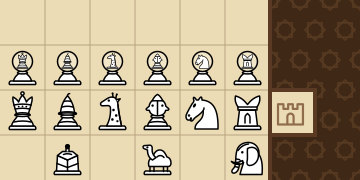
Timur’s great chess on an 11 × 10 board, with giraffes, camels and citadels.
 Play in your browser
The game runs in your browser and needs JavaScript.
What you can do here
- Bots from Novice to Club player, or friends online or at the same device
- A short course on the rules, task by task on the board
- Over 1,000 puzzles that adapt to your level
- Eleven kinds of pawn, each promoting to its own piece
How Tamerlane chess is played
Tamerlane chess was the great chess of Timur’s court in the 14th century: Shatranj on a board of eleven files and ten ranks, with six more kinds of piece and a pawn for each. The goal is to checkmate the opposing king: to attack it so that no move can save it. An attacked king is in check, and no move may leave your own king attacked.
The board and the start
The board has eleven files, a to k, and ten ranks, all squares alike, and two citadels: one beside White’s k2, one beside Black’s a9. On White’s first rank stand the elephants (a1, k1), the camels (c1, i1) and the war engines (e1, g1); on the second the rooks, knights, scouts, giraffes, the fers on e2, the king on f2 and the vizier on g2; on the third the eleven pawns. Black stands the same way, turned round.
The pieces
The king steps one square in any direction, the rook moves along ranks and files, the knight jumps in an L. The fers steps one square diagonally, the vizier one square straight. The elephant jumps exactly two squares diagonally and the war engine exactly two straight; the camel jumps one square one way and three the other, a long knight. The scout moves diagonally like a bishop, but always at least two squares. The giraffe steps one square diagonally and then goes on straight for three squares or more; it never jumps, so every square on its way must be empty.
Pawns
A pawn moves one square forward and captures one square diagonally forward; there is no double step and no en passant. Each pawn is named after a piece and becomes that piece on the last rank: the pawn of rooks a rook, the pawn of giraffes a giraffe. The pawn of kings becomes a prince, who moves like a king.
The pawn of pawns
On the last rank the pawn of pawns stays where it is, and nobody can take it. Later its owner may put it on any square from which it attacks two enemy pieces, or one that cannot move, and whatever stood there leaves the board; then it walks on as a pawn. On the last rank again it goes to the start square of the pawn of kings (f3 or f8), and the third time it becomes an adventitious king.
The prince and the adventitious king
They move like the king. While a side has more than one of them, none is in check: they may be taken like other pieces. Only the last one left must be kept out of check.
The king’s swap
Once a game, when the king is in check or its side has no other move, it may change places with any of its own pieces, as long as it does not stand in check afterwards.
The citadels
A king that steps into the citadel in the opponent’s half draws the game (if the king is gone, the prince may do it). No other piece may enter it. A side’s own citadel is for its adventitious king alone, where nothing can take it.
Winning
Checkmate wins, and so does stalemate: a player who cannot move loses. A bare king does not lose: it can still run for the citadel.
Draws
A king in the opponent’s citadel draws. The sources know no other draw; so that every game ends, the same position three times or fifty moves each without a capture or a pawn move is a draw here too.
The story
Persia · the 14th and 15th centuries
When and where
Tamerlane chess is the great chess of the court of Timur (1336–1405), the conqueror of Central Asia and Persia. His biographer Ibn Arabshah wrote that Timur played only the great chess, on a board of ten squares by eleven, and that the small chess was a mere nothing beside it.
How it changed
It kept the pieces of Shatranj and added a vizier, two giraffes, two scouts, two camels and two war engines, and eleven pawns, each named after a piece and promoting to it. Two citadels jut out of the board: a king that reaches the one in the opponent’s half draws the game. The fullest account of its rules is a Persian manuscript kept by the Royal Asiatic Society.
Today
H. J. R. Murray (1913) thought it had been forgotten in the East since Timur’s day, and that it was better known than it deserved, thanks to Timur, that manuscript and the praise of Forbes’ History of Chess. It is played today from the manuscripts and from modern reconstructions.
Did you know?
Timur named his son Shah Rukh, his biographer says, because the news of the birth came while he was giving the check shah rukh, king and rook, in a game of chess. The best player of his court, ‘Ali ash-Shatranji, played the great chess with him.
Original piece names
shah (king) · firzan (fers) · wazir (vizier) · zurafa (giraffe) · tali‘a (scout) · faras (knight) · rukh (rook) · pil (elephant) · jamal (camel) · dabbaba (war engine) · baidaq (pawn) · shahzada (prince) · shah masnu‘a (adventitious king)
Sources: H. J. R. Murray, A History of Chess (1913) · Wikipedia · The Chess Variant Pages
More games
Chess and variants
- Chess · Classic chess, or Chess960 with a shuffled back rank.
- Chess960 · Fischer random chess: the back rank starts in one of 960 setups.
- Antichess · Losing chess: give away all your pieces, captures are compulsory.
- Extinction chess · No check: take every enemy man of one kind, the king or all the pawns.
- Knightmate · Chess with a royal knight: mate the knight; the kings are ordinary men.
- Atomic chess · Every capture is an explosion that clears the pieces around it.
- Crazyhouse · Captured pieces change sides and can be dropped back onto the board.
- Hostage chess · Captured men become hostages and come back by exchange or from the airfield.
- Circe chess · A captured man goes straight back to its home square, if it is free.
- Three-check · Chess where the third check wins, so every check counts.
- King of the Hill · Chess where a king that reaches the centre wins at once.
- Jeson Mor · Mongolia’s nine horses: take the centre and hold it for a move.
- Racing Kings · No pawns, no checks: the first king on the far rank wins.
- Horde · 36 white pawns storm a full black army.
- Dunsany’s chess · Lord Dunsany’s game of 1942: 32 pawns against a full army.
- Los Alamos chess · Chess on 6 × 6 without bishops, the first game a computer played (1956).
- Gardner’s minichess · Chess on 5 × 5 with every piece, proved a draw with best play.
- Duck chess · After every move you move the duck, which blocks everyone. No check.
- Marseillais chess · Two moves a turn, with one piece or two; White starts with one.
- Progressive chess · One move, then two, then three: each turn is one move longer.
- Fog of War · You only see where your pieces can move. Capture the king to win.
- Kriegspiel · Only your own pieces in sight; an umpire judges every move.
- Alice chess · Two boards: every piece that moves passes through to the other one.
- Raumschach 3D · Chess in a 5 × 5 × 5 cube: five boards stacked, and the unicorn.
- Old Raumschach · Maack’s cube as played before 1919: five pawns above the pieces.
- Friendly Chess · Nothing is captured: pieces unite and set off chain reactions.
- Ultima · Every piece captures its own way, and the immobilizer freezes.
- Gliński’s hexagonal chess · Chess on 91 hexagons: three bishops, rooks in six directions.
- McCooey’s hexagonal chess · Hexagonal chess closer to chess: seven pawns that take diagonally.
- Shafran’s hexagonal chess · Hexagonal chess on 70 cells, with castling and pawns that step three.
- Maharajah and the Sepoys · One king with a queen’s and a knight’s moves against a whole army.
- Spartan chess · Persians against Spartans: chess’ army against two kings and new pieces.
- Legan chess · The armies in opposite corners; pawns step diagonally towards the far one.
Big chess
- Complete chess · The Arabic chess of the 9th century on 10 × 10, with two dabbābas a side.
- Carrera’s chess · The first chess on ten files, from a Sicilian priest’s book of 1617.
- Duke of Rutland’s chess · Fourteen files, with the concubine and two crowned rooks a side.
- Bird’s chess · Henry Bird’s ten-file chess of 1874, with the guard and the equerry.
- Capablanca chess · Ten files and two new pieces: the archbishop and the chancellor.
- Gothic chess · Ed Trice’s setup of 2000, today called Trice’s Chess.
- Capablanca Random · Capablanca chess from one of 12,118 shuffled starts.
- Embassy chess · Grand chess’ row of pieces on a 10 × 8 board.
- Janus chess · Two januses a side, each moving as a bishop or a knight.
- Grand chess · Christian Freeling’s 10 × 10 game: pawns promote only to lost pieces.
- Wildebeest chess · Eleven files, with two camels and a wildebeest on each side.
- Shako · Chess on 10 × 10 with xiangqi’s cannon and Shatranj’s elephant.
- S-chess · Chess with a hawk and an elephant in hand, placed as the back rank leaves.
Historical chess
- Chaturanga · India’s ancient chess, the root of the family: take the king to win.
- Shatranj · The medieval ancestor of chess, with a weak ferz and a jumping alfil.
- Byzantine chess · Shatranj on a round board: the rook circles, pawns never promote.
- Medieval chess · Europe’s chess before 1475: the ferz and the king may leap on their first move.
- Senterej · Ethiopian chess: no turns until the first capture, then Shatranj.
- Shatar · Mongolian chess: the bers, the camel, and a mate that needs a shak.
- Courier chess · Medieval Germany’s chess on a 12 × 8 board, with the courier, the man and the schleich.
- Grande Acedrex · Alfonso X’s great chess on a 12 × 12 board, with lions, giraffes and a roc.
Asia
- Makruk · Thai chess: a slow, strategic game with a counting rule.
- Ouk Chatrang · Cambodian chess: Makruk with a leap for the king and the met.
- Sittuyin · Burmese chess: set up your pieces, then promote on the diagonals.
- Kar Ouk · Ouk Chatrang where the first check wins: guard your king.
- Malay chess · Chess of the Malay world: the king leaps, a crowned pawn walks back.
- Batak chess · The Batak of Sumatra’s chess: the king leaps forward, a pin disarms.
- Xiangqi · Chinese chess: a river, palaces and a cannon that jumps to capture.
- Minixiangqi · Xiangqi on 7 × 7 points: no river, no advisors, no elephants.
- Manchu chess · Red’s lone chariot moves as horse and cannon too, against a full army.
- Jieqi · Xiangqi with the pieces face down: each is revealed by its first move.
- Banqi · Xiangqi’s pieces face down on half a board: turn them up, take by rank.
- Janggi · Korean chess: no river, palace diagonals and a cannon that always jumps.
- Shogi · Japanese chess: captured pieces return to the board on your side.
- Minishogi · Shogi on a 5 × 5 board: six pieces a side, short and sharp games.
- Chu shogi · Japan’s great shogi on 12 × 12: no drops, and a lion that moves twice.
- Tori shogi · Bird shogi on 7 × 7: a phoenix, quails and swallows, with drops.
- Kyoto shogi · Small shogi on 5 × 5: every piece turns over after each move.
- Annan shogi · Shogi where each piece moves as the friendly piece right behind it.
More players
- Chaturaji · India’s four-handed chess: kings can be captured, captures score.
- Seven Kingdoms chess · The seven Warring States round the Zhou king on a go board.
- Four Seasons Chess · Alfonso X’s chess for four from 1283: four seasons, the last king wins.
- Three-player chess · Three armies on a hexagonal board: you against two bots.
- Four-player chess · Four armies on a cross-shaped board: in teams or all against all.
- Bughouse · Two boards, two teams: what you capture goes to your partner's hand.
- Eight-player chess · Eight armies on a board of 516 squares: all against all, in pairs or four against four.
- Verney’s four-handed chess · Verney’s game of 1881: two against two, mate both enemy kings.
- Verney’s eight-handed chess · Verney’s game for eight of 1884: four against four on 448 squares.
- Verney’s three-handed round chess · Verney’s chess for three on a round board: mate both others.
- Morzeux’s chess for sixteen · Sixteen armies on one board of 693 squares, everyone for points.