Asia
Makruk
Thai chess: a slow, strategic game with a counting rule.
 Play in your browser
The game runs in your browser and needs JavaScript.
What you can do here
- Bots from Novice to Club player, or friends online or at the same device
- A short course on the rules and the classic techniques, task by task on the board
- Over 1,000 puzzles that adapt to your level
- The endgame count kept for you in the player bar
How Makruk is played
Makruk is the chess of Thailand, a living game. Whoever knows chess knows its board and most of its moves, but the pieces are slower and the pawns meet early. The goal is to checkmate the opposing king: to attack it so that no move can save it. An attacked king is in check, and no move may leave your own king attacked.
The pieces
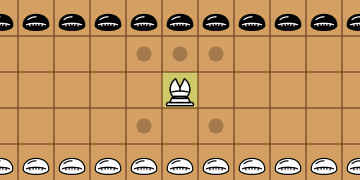
The king steps one square in any direction. The rook moves any number of squares along a rank or file, and the knight jumps in an L, two squares one way and one to the side, over whatever stands between. The met, beside the king, steps one square diagonally. The khon, beside the knight, steps one square diagonally in any direction or one square straight forward. Only the knight jumps over other pieces, and a piece captures by moving onto an enemy piece. There is no castling.
Pawns
Pawns start on the third rank. A pawn moves one square forward and captures one square diagonally forward; there is no double step and no en passant. A pawn that reaches the sixth rank, where the opponent’s pawns started, always becomes a met.
Winning and draws
Checkmate wins. Stalemate is a draw, and so is the same position three times, or a position in which neither side has enough left to mate (a lone met or knight, or a pawn, which can only become a met).
The counting rule
Once no pawn is left, a won ending must be finished in time. Counting starts by itself and is shown in the counting side’s bar. While both sides have pieces, it runs to 64. When one side has only its king, that side counts from the number of pieces on the board, and the limit depends on what the other side has: 8 with two rooks, 16 with one rook, 22 with two khons, 32 with two knights, 44 with one khon, 64 otherwise. If the count reaches the limit without a mate, the game is drawn.
The story
Thailand (Siam) · first reported in 1687–88, probably older; played to this day
When and where
Makruk is the chess of Thailand, once called Siam. The first outside report is a French envoy's: after his visit of 1687–88 he wrote only that the Siamese played chess. How the game arrived is debated: straight from India, perhaps with Buddhism, from the Khmer of Cambodia, or through Persian traders.
How it changed
Makruk kept the short steps of the oldest chess. The met moves one square diagonally, and the khon steps diagonally or straight ahead, a move al-Biruni saw in India around 1030. The pawns start on the third rank, and in a won ending a count of moves decides whether the mate comes in time.
Today
Thailand plays it in clubs, shopping malls and a national championship that recently drew about 300 qualifiers. The 2025 Southeast Asian Games in Bangkok held four makruk events.
Did you know?
The pawns were once cowrie shells. A pawn that reaches the sixth rank is turned over, and its name changes from bia, cowrie, to bia ngai, the overturned cowrie.
Original piece names
khun (lord, the king) · met (seed, the counsellor) · khon (nobleman, the elephant) · ma (horse) · ruea (boat, the rook) · bia (cowrie shell, the pawn) · bia ngai (overturned cowrie, a promoted pawn)
Sources: Wikipedia · Jean-Louis Cazaux · Simon de La Loubère (1693)
More games
Chess and variants
- Chess · Classic chess, or Chess960 with a shuffled back rank.
- Chess960 · Fischer random chess: the back rank starts in one of 960 setups.
- Antichess · Losing chess: give away all your pieces, captures are compulsory.
- Extinction chess · No check: take every enemy man of one kind, the king or all the pawns.
- Knightmate · Chess with a royal knight: mate the knight; the kings are ordinary men.
- Atomic chess · Every capture is an explosion that clears the pieces around it.
- Crazyhouse · Captured pieces change sides and can be dropped back onto the board.
- Hostage chess · Captured men become hostages and come back by exchange or from the airfield.
- Circe chess · A captured man goes straight back to its home square, if it is free.
- Three-check · Chess where the third check wins, so every check counts.
- King of the Hill · Chess where a king that reaches the centre wins at once.
- Jeson Mor · Mongolia’s nine horses: take the centre and hold it for a move.
- Racing Kings · No pawns, no checks: the first king on the far rank wins.
- Horde · 36 white pawns storm a full black army.
- Dunsany’s chess · Lord Dunsany’s game of 1942: 32 pawns against a full army.
- Los Alamos chess · Chess on 6 × 6 without bishops, the first game a computer played (1956).
- Gardner’s minichess · Chess on 5 × 5 with every piece, proved a draw with best play.
- Duck chess · After every move you move the duck, which blocks everyone. No check.
- Marseillais chess · Two moves a turn, with one piece or two; White starts with one.
- Progressive chess · One move, then two, then three: each turn is one move longer.
- Fog of War · You only see where your pieces can move. Capture the king to win.
- Kriegspiel · Only your own pieces in sight; an umpire judges every move.
- Alice chess · Two boards: every piece that moves passes through to the other one.
- Raumschach 3D · Chess in a 5 × 5 × 5 cube: five boards stacked, and the unicorn.
- Old Raumschach · Maack’s cube as played before 1919: five pawns above the pieces.
- Friendly Chess · Nothing is captured: pieces unite and set off chain reactions.
- Ultima · Every piece captures its own way, and the immobilizer freezes.
- Gliński’s hexagonal chess · Chess on 91 hexagons: three bishops, rooks in six directions.
- McCooey’s hexagonal chess · Hexagonal chess closer to chess: seven pawns that take diagonally.
- Shafran’s hexagonal chess · Hexagonal chess on 70 cells, with castling and pawns that step three.
- Maharajah and the Sepoys · One king with a queen’s and a knight’s moves against a whole army.
- Spartan chess · Persians against Spartans: chess’ army against two kings and new pieces.
- Legan chess · The armies in opposite corners; pawns step diagonally towards the far one.
Big chess
- Complete chess · The Arabic chess of the 9th century on 10 × 10, with two dabbābas a side.
- Carrera’s chess · The first chess on ten files, from a Sicilian priest’s book of 1617.
- Duke of Rutland’s chess · Fourteen files, with the concubine and two crowned rooks a side.
- Bird’s chess · Henry Bird’s ten-file chess of 1874, with the guard and the equerry.
- Capablanca chess · Ten files and two new pieces: the archbishop and the chancellor.
- Gothic chess · Ed Trice’s setup of 2000, today called Trice’s Chess.
- Capablanca Random · Capablanca chess from one of 12,118 shuffled starts.
- Embassy chess · Grand chess’ row of pieces on a 10 × 8 board.
- Janus chess · Two januses a side, each moving as a bishop or a knight.
- Grand chess · Christian Freeling’s 10 × 10 game: pawns promote only to lost pieces.
- Wildebeest chess · Eleven files, with two camels and a wildebeest on each side.
- Shako · Chess on 10 × 10 with xiangqi’s cannon and Shatranj’s elephant.
- S-chess · Chess with a hawk and an elephant in hand, placed as the back rank leaves.
Historical chess
- Chaturanga · India’s ancient chess, the root of the family: take the king to win.
- Shatranj · The medieval ancestor of chess, with a weak ferz and a jumping alfil.
- Byzantine chess · Shatranj on a round board: the rook circles, pawns never promote.
- Medieval chess · Europe’s chess before 1475: the ferz and the king may leap on their first move.
- Senterej · Ethiopian chess: no turns until the first capture, then Shatranj.
- Shatar · Mongolian chess: the bers, the camel, and a mate that needs a shak.
- Courier chess · Medieval Germany’s chess on a 12 × 8 board, with the courier, the man and the schleich.
- Grande Acedrex · Alfonso X’s great chess on a 12 × 12 board, with lions, giraffes and a roc.
- Tamerlane chess · Timur’s great chess on an 11 × 10 board, with giraffes, camels and citadels.
Asia
- Ouk Chatrang · Cambodian chess: Makruk with a leap for the king and the met.
- Sittuyin · Burmese chess: set up your pieces, then promote on the diagonals.
- Kar Ouk · Ouk Chatrang where the first check wins: guard your king.
- Malay chess · Chess of the Malay world: the king leaps, a crowned pawn walks back.
- Batak chess · The Batak of Sumatra’s chess: the king leaps forward, a pin disarms.
- Xiangqi · Chinese chess: a river, palaces and a cannon that jumps to capture.
- Minixiangqi · Xiangqi on 7 × 7 points: no river, no advisors, no elephants.
- Manchu chess · Red’s lone chariot moves as horse and cannon too, against a full army.
- Jieqi · Xiangqi with the pieces face down: each is revealed by its first move.
- Banqi · Xiangqi’s pieces face down on half a board: turn them up, take by rank.
- Janggi · Korean chess: no river, palace diagonals and a cannon that always jumps.
- Shogi · Japanese chess: captured pieces return to the board on your side.
- Minishogi · Shogi on a 5 × 5 board: six pieces a side, short and sharp games.
- Chu shogi · Japan’s great shogi on 12 × 12: no drops, and a lion that moves twice.
- Tori shogi · Bird shogi on 7 × 7: a phoenix, quails and swallows, with drops.
- Kyoto shogi · Small shogi on 5 × 5: every piece turns over after each move.
- Annan shogi · Shogi where each piece moves as the friendly piece right behind it.
More players
- Chaturaji · India’s four-handed chess: kings can be captured, captures score.
- Seven Kingdoms chess · The seven Warring States round the Zhou king on a go board.
- Four Seasons Chess · Alfonso X’s chess for four from 1283: four seasons, the last king wins.
- Three-player chess · Three armies on a hexagonal board: you against two bots.
- Four-player chess · Four armies on a cross-shaped board: in teams or all against all.
- Bughouse · Two boards, two teams: what you capture goes to your partner's hand.
- Eight-player chess · Eight armies on a board of 516 squares: all against all, in pairs or four against four.
- Verney’s four-handed chess · Verney’s game of 1881: two against two, mate both enemy kings.
- Verney’s eight-handed chess · Verney’s game for eight of 1884: four against four on 448 squares.
- Verney’s three-handed round chess · Verney’s chess for three on a round board: mate both others.
- Morzeux’s chess for sixteen · Sixteen armies on one board of 693 squares, everyone for points.